The Engineered Edge: Why Weld-On Barrel Hinges with Grease Zerks Dominate Heavy Fabrication
When dealing with massive deadweight—like multi-ton industrial gates, high-vibration dump trailers, or hard-working agricultural equipment—standard hardware components will inevitably deform, snap, or seize.
For projects requiring permanent structural integrity and frictionless movement, the industry solution is the Heavy-Duty Weld-On Barrel Hinge featuring an integrated Grease Zerk.
Anatomy of a High-Performance Bullet Hinge
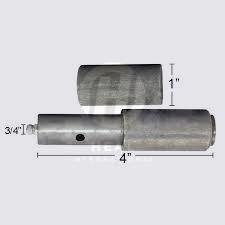
Unlike standard residential or bolt-on varieties, a commercial weld-on barrel hinge (frequently called a bullet hinge) features a compact, two-part cylindrical profile.
- The Female Barrel: Welded onto the moving frame/structure.
- The Male Pin/Barrel Assembly: Welded securely onto the stationary post.
- The Internal Brass Washer: Acts as a low-friction load-bearing interface between the two steel components.
The Lubrication Mechanics (The Zerk Advantage)
The integrated Grease Zerk (grease nipple) acts as a specialized check valve built into the hinge capsule. When pressurized grease is injected using a mechanical grease gun, it fills the internal reservoir, coating the central pin. This eliminates raw metal-on-metal shearing, flushes out abrasive dust particles, and halts structural rust before it can bind the assembly.
Technical Specifications & Sizing Framework
Selecting appropriate hardware dimensions prevents premature drop, lean, or sagging in heavy metal gate fabrications.
| Parameter | Performance & Structural Baseline |
| Material Base | High-tensile Mild Steel, Heavy Carbon Alloys, or Grade 316 Stainless Steel |
| Mounting Style | Permanent structural arc/MIG welding installation |
| Lubrication Port | Threaded or press-fit Brass/Steel Grease Zerk |
| Swing Field | Full 180-degree unobstructed radial path |
| Internal Design | Precision-machined fixed pin setups or heavy-duty removable configurations |
| Application Scope | Industrial machinery, low-loader trailer gates, heavy-duty utility doors |
The Operational Benefits of Grease-Port Engineering
- Minimal System Downtime: Maintenance cycles are reduced to seconds per hinge point, requiring no hardware disassembly or frame unpinning.
- Superior Anti-Seize Shielding: Injecting fresh grease creates a structural barrier against rainwater infiltration, chemical washdowns, and road salt degradation.
- Substantial Load Distribution: The circular design distributes horizontal tension and vertical shear forces evenly over the full length of the weld bead.
- Acoustic Dampening: Eliminates high-frequency metal squeaks and grinding noises under extreme physical tension.
Critical Action Steps: The Weld-On Installation Sequence
Achieving optimal performance depends heavily on structural squareness, solid joint alignment, and precise thermal control during your welding run.
1.Substrate Decontamination:Phase 1.
Grind away all mill scale, structural paint, surface oxidization, or shop oils from the specific zones on your structural post and door frame.
2.Axial Alignment & Clamping:Phase 2.
Position your barrel hinges along a perfectly plumb vertical axis line. Clamp them securely into place using heavy-duty locking metal fabricator clamps to counteract heat movement.
3.Balanced Tack Welding:Phase 3.
Apply small, highly concentrated tack welds at opposite corners of the hinge blocks. This locks their location while allowing for final testing before completing full structural runs.
4.Kinematic Swing Verification:Phase 4.
Manually cycle the gate or industrial door through its complete movement arc. Ensure there is zero mechanical binding, drag, or friction along the pivot points.
5.Final Structural Welds:Phase 5.
Lay down solid, continuous structural weld beads along the hinge margins. Avoid concentrated heat buildup on the central barrel area to protect internal brass washers and avoid pin warping.
6.Controlled Cool-Down:Phase 6.
Allow your finished weld zone to cool down slowly at ambient room temperature. Do not apply liquid cooling agents, as sudden temperature drops embrittle the steel matrix.
7.Lubricant Injection Run:Phase 7.
Attach a standard grease gun coupler to the zerk nipple and feed high-pressure grease into the port until you see the grease cleanly seal the outer seams.
High-Performance Maintenance Strategy
Pro-Tip from Fabricators: Always service high-load industrial gates right after seasonal transitions. Cold winter periods require high-viscosity lubricants, whereas hot summer environments call for a stable grease barrier that won’t thin out and drip free from the internal core.
- Regular Structural Purging: Pump new grease into the fitting until old, contaminated grease is pushed out from the bottom seam, carrying away trapped grit.
- Weld Joint Stress Audits: Routinely inspect the weld fillets for signs of stress corrosion cracking or micro-fissures from heavy wind load impacts.
- Corrosion Control: Treat heat-affected areas adjacent to the welds with high-zinc cold-galvanizing primers or industrial enamel finishes.